Kilns & Firing field guide
How to Keep a Kiln Firing Log (With a Free Template)
What to record for every bisque and glaze firing — program, load, witness cones, time, cost and results — and how to read the log to fix uneven or slow firings.
A kiln log turns every firing into evidence. Without one, a crazed glaze or a pale cone 6 load is a mystery; with one, it is usually two lines of arithmetic away from an answer.
Why keep a kiln log at all?
A controller remembers the program, not the result. The same program fires differently as elements age, as the load gets heavier, and as the kiln moves from a cold garage in winter to a warm one in summer. A log is how you notice those changes before they cost you a load.
It also answers the questions potters ask after a disappointing firing: Was it the glaze or the kiln? Was the top shelf colder than the bottom? Did the firing take longer than usual? You can only answer those with records from the firings that went well.
What to record for every firing
| Field | Example | Why it matters |
|---|---|---|
| Firing number and date | #47 · 3 Nov | Lets you refer to a firing from a piece's notes |
| Kiln and type of firing | Studio kiln · glaze | Bisque and glaze results are not comparable |
| Program | Ramps, target temperature or cone, holds | The first suspect when results change |
| Load | What is on each shelf, how full | Heavy loads heat and cool more slowly |
| Witness cones | Cone 5 · 6 · 7 per shelf, and the bend | What the ware actually received |
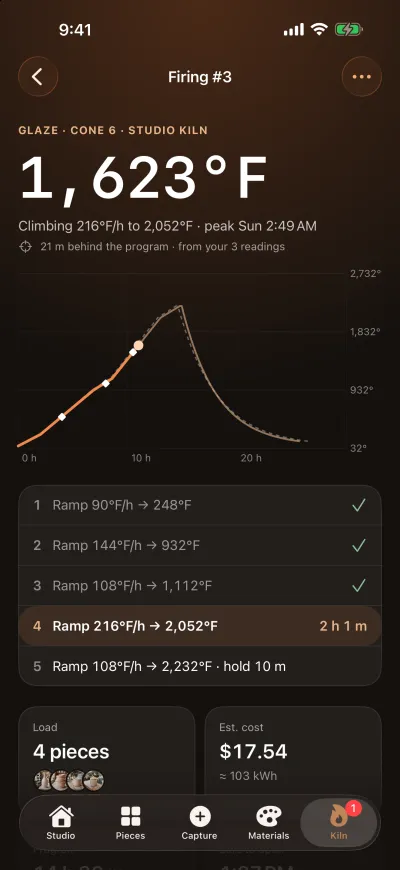
| Time | Start, peak, total hours | Longer firings point to tired elements |
| Energy or fee | Meter readings or the firing service fee | Real cost per firing and per piece |
| Results | By shelf: good, crazing, pinholes, under-fired | Patterns appear only across firings |
Witness cones: the most useful line in the log
Pyrometric cones measure heatwork, the combined effect of temperature and time, which is what your clay and glaze respond to. A thermocouple measures only temperature. That is why two firings can reach the same number on the controller and still give different results.
The common practice is a cone pack of three: a guide cone one number below your target, the firing cone, and a guard cone one number above. For a cone 6 glaze firing that is cones 5, 6 and 7. A correctly fired cone has bent until its tip is level with its base. Place one pack on each shelf where you can see or reach it, and record the bend of each cone after the firing — for example "5 down, 6 at 3 o'clock, 7 standing".
Orton's chart gives the temperature at which each cone bends for three heating rates; for cone 6 at 60 °C per hour over the last 100 °C, it is 1222 °C (2232 °F). The full table is on our cone chart and temperature calculator.
How to read the log: three patterns worth spotting
The top shelf is always a cone cooler
If the guard cone on the bottom shelf bends while the firing cone on top barely moves, the kiln is uneven. Many controllers have zone control or offsets; otherwise, put the glazes that tolerate a little less heat on the cooler shelf, or add a short hold at peak and check the next log entry.
Firings are slowly getting longer
When the same program takes longer to reach peak over several months, the elements are usually wearing out. Kiln makers publish the resistance of new elements; measuring and recording it every few months tells you when to replace them, before a firing stalls short of temperature.
One glaze fails only in full loads
Heavy loads cool more slowly. A glaze that looks right in a half-empty kiln but turns matte or crystalline in a packed one is responding to the cooling, not the peak. A controlled cooling segment in the program is often the fix — and the log is how you prove it.
A simple paper template
If you prefer paper, keep one page per firing and fill it in at three moments: when you load, when you start, and when you unload.
| Shelf | What was on it | Guide cone | Firing cone | Guard cone | Result |
|---|---|---|---|---|---|
| 1 | |||||
| 2 | |||||
| 3 | |||||
| 4 |
Add the cost while you are at it
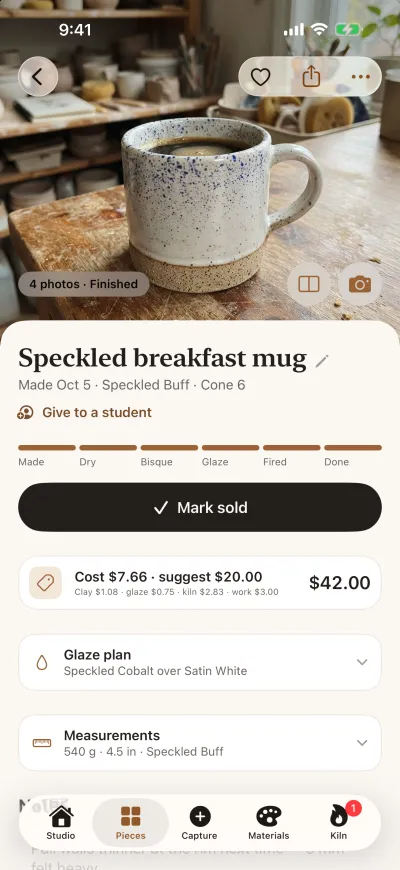
If your kiln has its own meter, or you know its power rating, the log can also tell you what each firing costs. Multiply the kilowatt-hours used by your electricity rate; the kiln firing cost calculator estimates it from the kiln's power and the firing time. Dividing by the number of pieces gives a firing cost per piece, which belongs in your prices — see how to price pottery.
Sources and further reading
Frequently asked questions
What should a kiln log include?
For each firing: the date and firing number, the kiln, bisque or glaze, the program (ramps, target cone or temperature, holds), what was on each shelf, the witness cone bend on each shelf, start and peak times, energy use or firing fee, and the results by shelf.
Why use witness cones if the kiln has a controller?
A controller measures temperature; cones measure heatwork, the combined effect of temperature and time that clay and glaze respond to. Two firings can reach the same controller reading and still give different results, which the cones show.
How can a kiln log show that elements need replacing?
If the same program takes longer to reach peak over several months, the elements are usually wearing. Recording firing times and the element resistance measured every few months shows the trend before a firing stalls short of temperature.
Use these calculations with the procedure
Editorial note
Found a source or calculation that needs correction?
See how formulas are selected, how changes are recorded, and how to send a reproducible correction in the ClayCalc methodology.
Continue reading