Studio Business field guide
How to Price Pottery: A Cost-Based Method for Handmade Ceramics
Price handmade pottery from materials, firing, labour and overhead, with a worked mug example, the costs potters forget, and gallery, Etsy and market fees.
Most handmade pottery is underpriced for one reason: the maker prices from what feels fair instead of from what the piece cost. A price built from real costs is easier to defend at a market, in a gallery and to yourself.
The pricing formula, step by step
Materials  = clay + glaze + extras (handles, decals, packaging)
Firing     = your share of each bisque and glaze firing
Labour     = hours × your hourly rate
Overhead   = (materials + firing + labour) × overhead %
Cost       = materials + firing + labour + overhead
Wholesale  = cost × 2
Retail     = wholesale × 2
The multipliers are a starting point, not a law. The aim is that wholesale covers your cost with a margin, and retail leaves room for a shop or gallery to take its share.
A worked example: one mug
| Item | How | Amount |
|---|---|---|
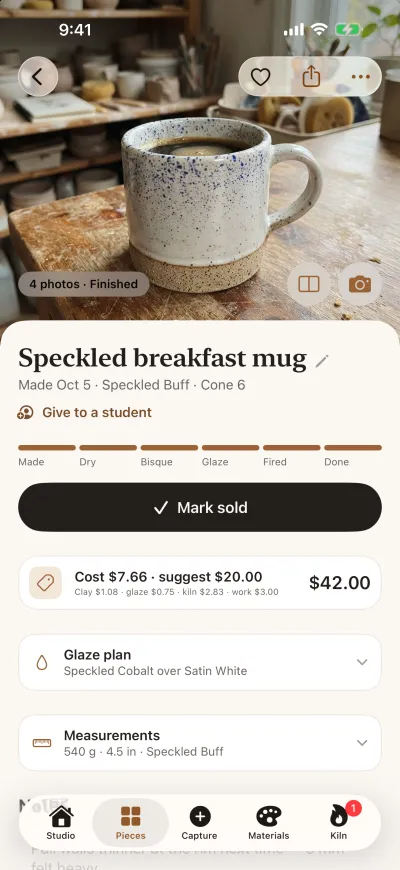
| Clay | 500 g of a $1.20/kg body | $0.60 |
| Glaze | About 60 g at $15/kg dry | $0.90 |
| Firing | Bisque + glaze firing share | $1.50 |
| Labour | 0.75 h × $20/h (throwing, trimming, handle, glazing) | $15.00 |
| Overhead | 20% of the above | $3.60 |
| Cost | $21.60 | |
| Wholesale | Cost × 2 | $43.20 |
| Retail | Wholesale × 2 | $86.40 |
Two lessons usually come out of this. First, labour dominates: materials are a few dollars, your hours are most of the cost. Second, a retail price that feels high is often simply honest. If $86 is more than your market will pay, the answer is to make the mug faster, make it in batches, or charge for the time — not to forget the time. The ceramic pricing calculator runs this formula with your numbers.
The costs potters forget
- Losses. If one pot in ten cracks, warps or comes out of the glaze firing with a flaw, the nine good ones carry its cost.
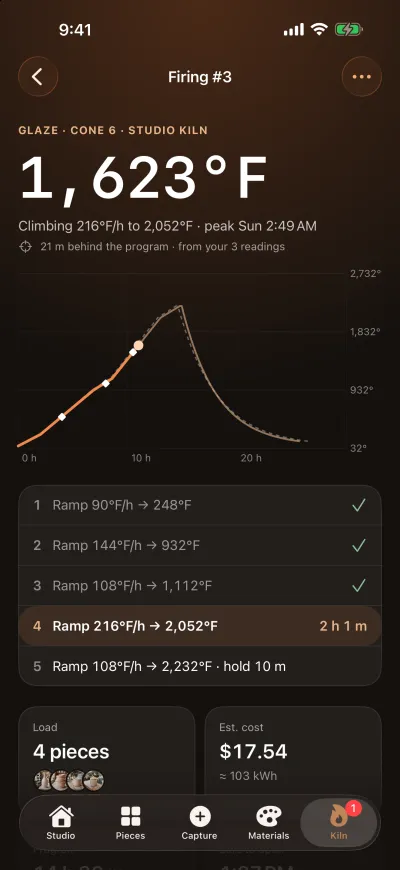
- Firing a half-empty kiln. Firing cost per piece depends on how full the load is; the kiln cost calculator estimates the cost of a firing from the kiln's power and the firing time.
- Unseen hours. Photographing, listing, packing, answering messages and standing at a market are all part of a piece's labour.
- Equipment wear. Elements, kiln shelves, the wheel and tools are overhead, spread across everything you make.
For a bottom-up cost per piece, including clay and glaze by weight, the unit cost calculator is more detailed.
Check the price against where you sell
| Where you sell | What comes off the retail price |
|---|---|
| Commercial gallery (full representation) | Commission generally 40–50% (NAVA Code of Practice) |
| Etsy | $0.20 listing fee, 6.5% transaction fee on price plus shipping, payment processing by country, and an Offsite Ads fee on orders from Etsy's ads |
| Markets and fairs | A stall fee, travel and your time on the day |
| Your own studio or website | Payment processing and your time; no commission |
Keep one retail price across channels so galleries are not undercut by your own website. The gallery commission calculator works backwards from what you need to keep, and the craft fair calculator shows how many pieces a stall has to sell to break even.
When to raise your prices
- Your work sells out at markets or within days of listing.
- You have a waiting list for commissions.
- Your clay, glaze or electricity costs have gone up — recalculate the cost at least once a year.
Small, regular increases are easier for customers to accept than one large jump after years of the same price.
Sources and further reading
Frequently asked questions
What is the formula for pricing pottery?
Cost = materials + firing + labour (hours × hourly rate) + overhead. A common rule of thumb is wholesale = cost × 2 and retail = wholesale × 2, then checked against what galleries, marketplaces and markets take.
How much does a gallery take from pottery sales?
For full representation by a commercial gallery, Australia's NAVA Code of Practice says commission generally varies between 40% and 50% of the sale price. Co-op and non-profit galleries may take less.
Why is my handmade pottery price so high on paper?
Because labour is most of the cost. Clay and glaze for a mug cost a few dollars; the hours of throwing, trimming, handling and glazing do not. Working in batches or faster methods lowers the cost; leaving time out of the price does not.
Use these calculations with the procedure
Editorial note
Found a source or calculation that needs correction?
See how formulas are selected, how changes are recorded, and how to send a reproducible correction in the ClayCalc methodology.
Continue reading