Glaze & Recipe field guide
How to Keep a Glaze Journal: Recipes, Layers and Results
The five facts to record for every glazed piece, a recipe page for each glaze, test tiles that answer questions, and how to note glaze fit and food safety.
Every potter has a pot they love and cannot repeat because nobody wrote down which glaze went on top, how thick, on which clay, in which firing. A glaze journal is the cure, and it only needs five facts per piece.
The five facts to record for every glazed piece
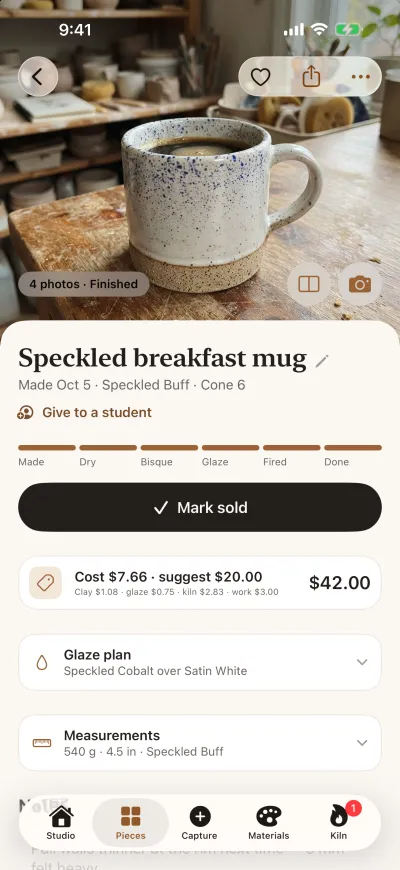
- Clay body. A glaze on porcelain and the same glaze on a speckled buff stoneware are two different results.
- Layers, in order. "Celadon over white satin" and "white satin over celadon" are not the same glaze. Write the inside and outside separately.
- Application. Dipped, poured, brushed or sprayed — and how thick: dip seconds, number of brush coats, or the glaze's specific gravity on the day.
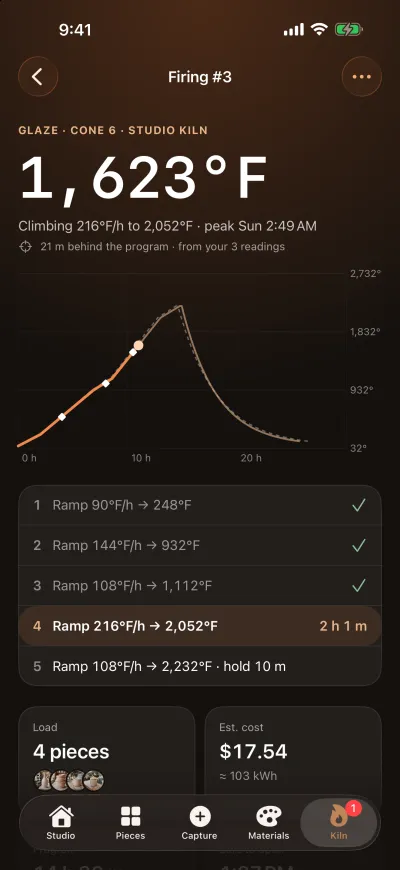
- Firing. Which firing number, which shelf and what the witness cones did. This links the journal to your kiln log.
- Result and photo. In daylight, on the same background, with a short verdict: "keep", "too runny", "pinholes", "crawled at the rim".
The recipe page for each glaze
Alongside the per-piece notes, give each glaze one page with its recipe in percentages that add up to 100, the colourants and opacifiers as additions, the cone it is meant for, and the batch you last mixed. Writing recipes as percentages makes them easy to scale to any batch size; the glaze batch calculator and the recipe scaler do the arithmetic.
Two more lines save a lot of guesswork later: the specific gravity you dip at (measure it with the glaze SG calculator) and any materials that are hard to replace. When a supplier discontinues a material, the recipe page tells you exactly which glazes need reformulating.
Test tiles that actually answer questions
A test tile is only useful if you can tell what it tested. Make tiles from the clay you will use, tall enough to show running, with a texture or carved line to show breaking over edges. Mark each tile with a code that survives firing — an underglaze pencil or a little iron oxide — and keep the same code in the journal.
| Tile code | Clay | Glazes (in order) | Application | Firing | Verdict |
|---|---|---|---|---|---|
| G-14a | Speckled buff | White satin, then celadon | Dip 3 s / dip 2 s | #47, shelf 2 | Keep |
| G-14b | Speckled buff | Celadon, then white satin | Dip 2 s / dip 3 s | #47, shelf 2 | Too dry |
| G-14c | Porcelain | White satin, then celadon | Dip 3 s / dip 2 s | #47, shelf 3 | Runs at foot |
Our glaze testing workflow covers how to go from a 100 g test batch to a production decision.
Record fit and safety, not just colour
Crazing (a network of fine cracks) and shivering (glaze flaking off edges) come from a mismatch between how much the glaze and the clay shrink on cooling. Note any crazing per clay body; it often appears days or weeks after the firing. The glaze fit (COE) calculator compares expansion values as a first check, but the piece in your hand is the real test.
For anything that will hold food or drink, record whether the glaze has been tested for durability and leaching, and by whom. A calculated recipe or a nice-looking surface does not establish food safety; a laboratory leach test does.
Make results easy to find again
A journal is only as good as its index. Whatever you use, make sure you can answer these three questions in under a minute:
- Which pieces used this glaze, and on which clays?
- What did this glaze look like the last three times it was fired?
- What exactly is on the mug a customer wants a matching set of?
On paper, that means one page per glaze with a running list of pieces; in a spreadsheet, a column for each glaze layer you can filter by.
Sources and further reading
Frequently asked questions
What should I write down when I glaze a pot?
The clay body, each glaze layer in order inside and outside, how it was applied (dip time, coats or specific gravity), the firing and shelf it went into, and a photo of the result with a short verdict.
Why does the same glaze look different on different clays?
The clay body changes colour, texture and how the glaze melts and fits. Iron in a buff or red clay, speckles, and the body's thermal expansion all show through, so results should be grouped by clay body.
Does a glaze recipe prove a glaze is food safe?
No. A recipe or calculation cannot establish food safety; a laboratory leach and durability test on the fired glaze, on your clay and in your firing, is what does.
Use these calculations with the procedure
Editorial note
Found a source or calculation that needs correction?
See how formulas are selected, how changes are recorded, and how to send a reproducible correction in the ClayCalc methodology.
Continue reading